



Singapore Launches Asia Pacific One Health Initiative to Spot Disease Threats Earlier
A new regional initiative based in Singapore aims to detect emerging infectious diseases earlier by bringing together human, wildlife and environmental health data.
- Initiative
- Asia Pacific One Health Initiative (APOHI), launched 3 November
- Supported by
- Temasek Foundation, the Gates Foundation, and the Health for Human Potential Community of the Philanthropy Asia Alliance
- Time frame
- Ten years, focused on integrated surveillance, predictive intelligence and cross-border research
- First programme
- Monkey malaria research in Borneo, involving Singapore, Malaysia, Indonesia and Brunei
Why a One Health Approach
Most emerging diseases move between people, animals and the environment. Dense populations and rich wildlife in the Asia-Pacific raise the risk of diseases passing from animals to humans. Surveillance has often worked in silos, with information split across institutions and borders, which makes early warning difficult. The initiative aims to link these signals, using a “one health” approach that its co-leads describe as easy to understand but harder to put into practice.
Lessons From Past Outbreaks
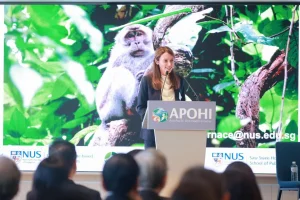
Infectious diseases specialist Leo Yee-Sin, a co-lead of APOHI, led teams through the SARS outbreak in 2003 and the Covid-19 pandemic. She said communication between countries and experts was limited during SARS, but that networks were stronger by the time of Covid-19, which helped the region share information and focus research on a new pathogen. She argued that Singapore should now do more to connect with the region on existing and emerging threats.
The First Project: Monkey Malaria
APOHI’s first project, led by spatial epidemiologist Kimberly Fornace, aims to identify areas in Borneo where macaques could carry a malaria parasite to people. Malaria can spread from monkeys to humans when a mosquito bites an infected monkey and then a person. The research looks at how changes in forests and land use, including fires that create new mosquito habitats, affect the risk. Forest edges close to settlements are a particular concern. The project will also test ways to share data across borders and analyse it together.
Challenges Ahead
Ng Boon Heong, chief executive of Temasek Foundation, said outbreaks are often first noticed in human patients because warning signs in animals and the environment are rarely brought together. Ian Cheong, a co-lead of APOHI, said the main hurdle is coordinating human, animal and environmental data, which requires relationships and a willingness among countries and disciplines to cooperate.